

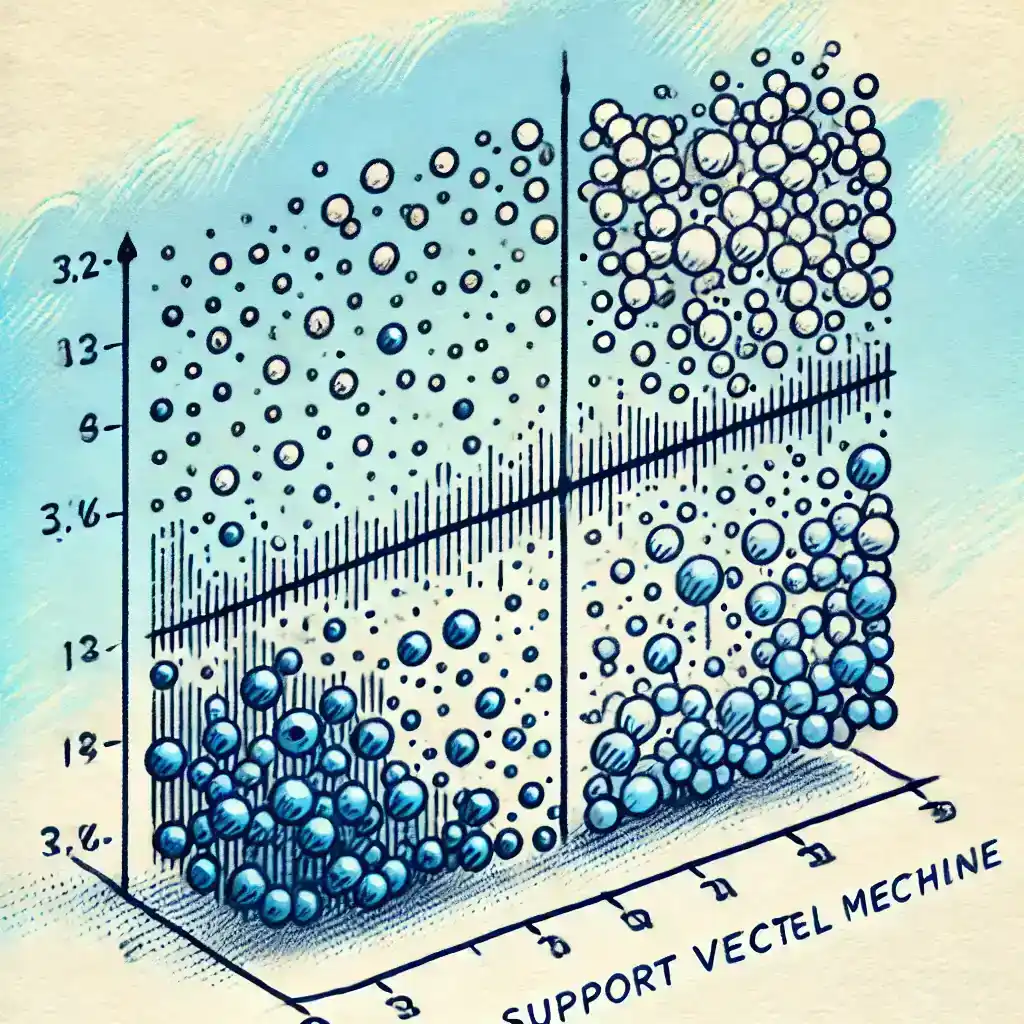
Understanding Support Vector Machines (SVM): A Powerful Classifier
Support Vector Machines (SVM) are a class of supervised learning algorithms that are widely used for classification and regression tasks. SVMs are known for their ability to handle high-dimensional data and their effectiveness in classification problems with clear margins of separation. They work by finding a hyperplane that best separates different classes in a dataset. SVM is one of the most powerful and efficient algorithms, particularly when the data is not linearly separable.
In this article, we will explore what Support Vector Machines are, how they work, their advantages and disadvantages, and how to implement them in Python.
What is a Support Vector Machine (SVM)?
A Support Vector Machine (SVM) is a supervised machine learning algorithm used for classification and regression tasks. The main idea behind SVM is to find a hyperplane that maximizes the margin between different classes. The hyperplane is the decision boundary that separates the data points of one class from another.
- Classification: In classification problems, SVM aims to find a hyperplane that divides the data points of different classes in such a way that the distance between the closest data points of both classes (called the margin) is as large as possible. This is referred to as the maximum margin classification.
- Regression: In regression tasks, SVM attempts to find a hyperplane that has the largest margin while allowing some errors (or slack) in the model to handle noisy data.
How Does SVM Work?
SVM works by finding the optimal hyperplane that maximizes the margin between classes. Here’s a step-by-step explanation of how SVM works:
Hyperplane:
A hyperplane is a flat affine subspace of one dimension less than the input space. In a 2D space, this would be a line, in 3D space, it would be a plane, and in higher dimensions, it is a hyperplane. SVM searches for this hyperplane that divides the classes in the best possible way.Support Vectors:
The data points closest to the hyperplane are called support vectors. These points are crucial because they are the ones that define the position and orientation of the hyperplane. Only the support vectors are used in the training of the SVM model, and they play an essential role in determining the decision boundary.Maximizing the Margin:
The margin is the distance between the hyperplane and the closest support vectors from either class. The goal of SVM is to maximize this margin to improve generalization. The larger the margin, the lower the generalization error. This is a key feature of SVM, as it ensures the model will be robust and accurate on unseen data.Kernel Trick (for Non-Linearly Separable Data):
In cases where the data is not linearly separable, Support Vector Machines uses a technique called the kernel trick. This involves transforming the data into a higher-dimensional space where it becomes linearly separable. The kernel function computes the inner product of data points in this higher-dimensional space without actually transforming the data, making it computationally efficient.Common kernel functions include:
- Linear Kernel: Used when data is linearly separable.
- Polynomial Kernel: Used for non-linear data.
- Radial Basis Function (RBF) Kernel: Often used in practice and performs well in many situations.
- Sigmoid Kernel: Less common but used in some cases.
Soft Margin:
In real-world scenarios, perfect separation of classes might not be possible due to noise and overlapping data points. To address this, Support Vector Machines allows some points to be on the wrong side of the margin (this is known as the soft margin). The soft margin is controlled by a parameter called C, which determines the trade-off between maximizing the margin and minimizing classification errors.
Types of SVM
Linear SVM:
- Used when the data is linearly separable. The algorithm finds a linear hyperplane that separates the data into different classes.
Non-Linear SVM:
- Used when the data is not linearly separable. This is achieved by using kernel functions, which transform the data into a higher-dimensional space where a linear separation is possible.
SVM for Regression (SVR):
- Support Vector Machines can also be used for regression tasks, where the goal is to predict a continuous value. The key difference is that in regression, we try to find a hyperplane that fits most of the data points while allowing some margin of error (controlled by the parameter C).
Advantages of SVM
High Accuracy:
Support Vector Machines is known for its high accuracy, especially in high-dimensional spaces. It is effective in situations where the number of features exceeds the number of data points.Effective in High Dimensions:
SVM works well with high-dimensional data and is often used in text classification, bioinformatics (e.g., gene classification), and image recognition tasks, where datasets often contain many features.Robust to Overfitting:
Support Vector Machines is less prone to overfitting, especially when a high-dimensional space is used. By maximizing the margin, it ensures the model is as generalized as possible.Flexibility with Kernels:
With the kernel trick, SVM can handle non-linear classification tasks by transforming the input space into higher dimensions where the data becomes separable.Versatility:
SVM can be used for both classification and regression tasks. This makes it a versatile tool that can be applied in various domains.
Disadvantages of SVM
Computationally Expensive:
SVM can be computationally expensive, especially for large datasets. The training time complexity can be high, which makes it less practical for very large datasets with millions of data points.Memory Intensive:
Storing all support vectors can require significant memory, which can be a concern when working with large datasets.Sensitive to Parameter Tuning:
SVM requires careful tuning of the hyperparameters, such as the kernel type, the regularization parameter (C), and the kernel-specific parameters (e.g., gamma for RBF kernel). Improper tuning can lead to poor model performance.Difficulty with Large Datasets:
SVM might not scale well to large datasets, particularly when using non-linear kernels. This is because SVM’s training time complexity is roughly O(n2)O(n^2) to O(n3)O(n^3), where nn is the number of data points.Less Interpretable:
While SVM provides excellent classification performance, it is considered a “black-box” model. It is difficult to interpret the decision boundary and understand how individual features contribute to the prediction, making it less interpretable compared to other models like decision trees.
Applications of SVM
Text Classification:
- Support Vector Machines is widely used in natural language processing (NLP) tasks, such as spam email detection, sentiment analysis, and document classification.
Image Classification:
- Support Vector Machines is used in image recognition tasks, such as identifying objects or faces in images. It has been applied to handwritten digit recognition (e.g., MNIST dataset).
Bioinformatics:
- Support Vector Machines is used in gene classification, protein structure prediction, and disease diagnosis, particularly in scenarios where the number of features (genes, proteins) is much higher than the number of samples.
Face Recognition:
- Support Vector Machines is used for facial recognition and emotion detection in security and surveillance systems.
Handwriting Recognition:
- SVMs are commonly used in optical character recognition (OCR) systems to classify handwritten characters.
Implementing SVM in Python
Here’s how to implement Support Vector Machines for classification using Scikit-learn:
import pandas as pd
from sklearn.model_selection import train_test_split
from sklearn.preprocessing import StandardScaler
from sklearn.svm import SVC
from sklearn.metrics import accuracy_score, confusion_matrix, classification_report
import matplotlib.pyplot as plt
# Example dataset: Iris dataset
from sklearn.datasets import load_iris
data = load_iris()
# Features and target
X = pd.DataFrame(data.data, columns=data.feature_names)
y = pd.Series(data.target)
# Splitting data into train and test sets
X_train, X_test, y_train, y_test = train_test_split(X, y, test_size=0.2, random_state=42)
# Feature scaling
scaler = StandardScaler()
X_train = scaler.fit_transform(X_train)
X_test = scaler.transform(X_test)
# Create and train the SVM classifier (with RBF kernel)
model = SVC(kernel=’rbf’, C=1, gamma=’scale’)
model.fit(X_train, y_train)
# Making predictions
y_pred = model.predict(X_test)
# Evaluating the model
accuracy = accuracy_score(y_test, y_pred)
print(f’Accuracy: {accuracy * 100:.2f}%’)
print(‘Confusion Matrix:’)
print(confusion_matrix(y_test, y_pred))
print(‘Classification Report:’)
print(classification_report(y_test, y_pred))
# Visualize the decision boundary (Optional: 2D or 3D visualization)
plt.scatter(X_test[:, 0], X_test[:, 1], c=y_pred, cmap=’viridis’, marker=’o’)
plt.title(‘SVM Classification with RBF Kernel’)
plt.xlabel(‘Feature 1’)
plt.ylabel(‘Feature 2’)
plt.colorbar()
plt.show()
